
Meet Stefan Vitanov
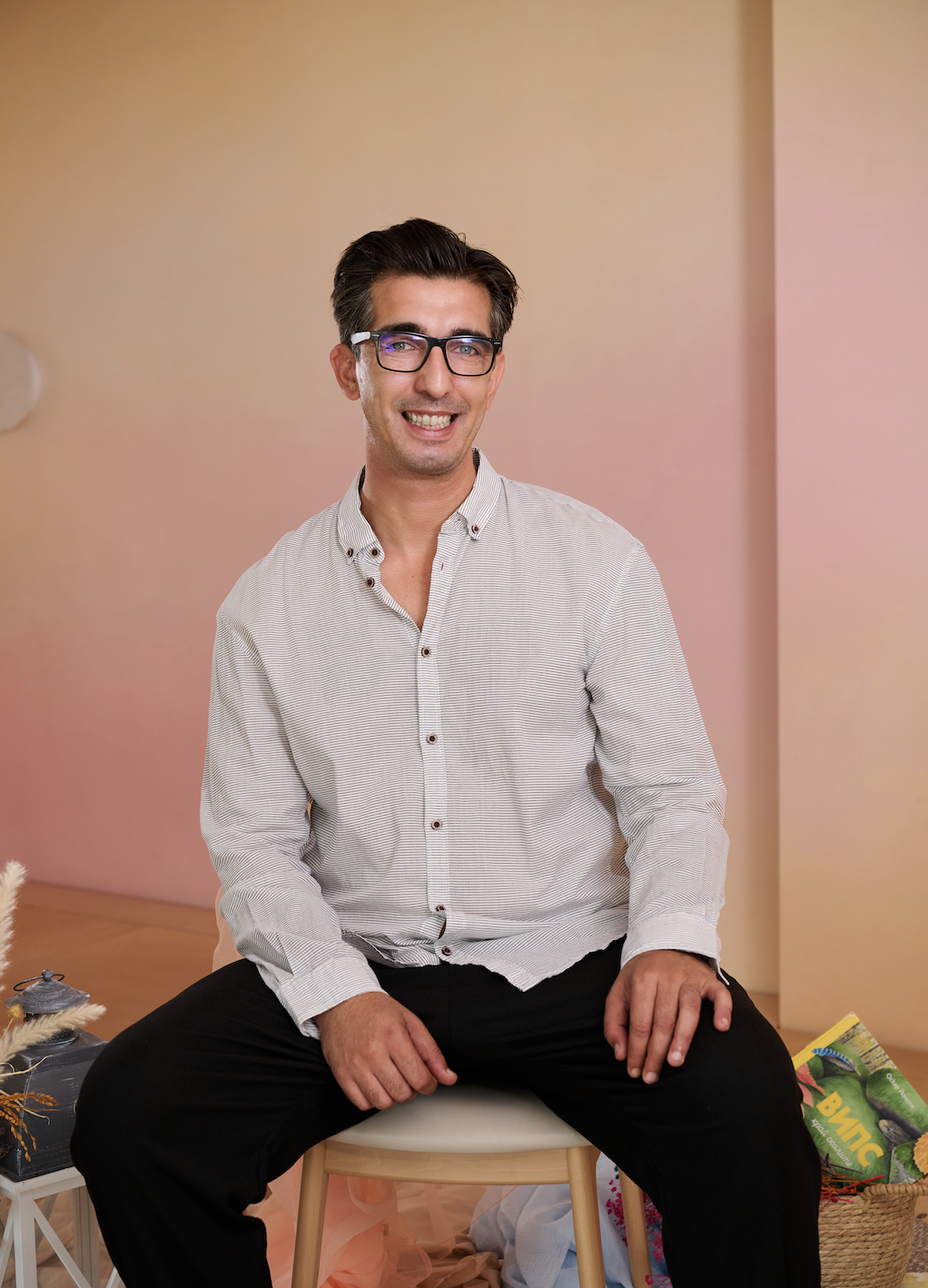
From the Stage to the Classroom
Interviewer: Tell me a little about yourself.
Stefan Vitanov: I was born in Sofia in 1984 and grew up in the Mladost neighbourhood, where I also went to school. I practised various sports and still do. In ninth or tenth grade, I discovered dance, and I haven’t left the stage since. I completed my secondary education with a focus on computer science and mathematics, although, as I like to say, my diploma is more of a formality.
After that, I went to study at the Academy of Music, Dance and Fine Arts in Plovdiv. I chose it because I’d been told that the training there was as demanding and rigorous as it gets. There were 120 applicants for 16 full-time places. I got in, and from then on, everything revolved around dance. I performed with the Academy’s representative ensemble and later became its ballet master. Then I started teaching. That was how I moved from the stage to working behind the scenes.
I: What made you decide to become a teacher?
S: I’ve always felt that I danced at a time when the generation of dancers was exceptionally good. Truly good. And I believed that when I stopped dancing, everything I had accumulated over the years shouldn’t simply end with me. I don’t just mean my knowledge and experience as a dancer and choreographer, but also my convictions about art. Of course, these things don’t begin or end with one person. They have to be passed on. I felt I had something to offer my students, and that’s why I became a teacher.
In fact, I went back to teach at my own school. I didn’t want to teach anywhere else. I made the decision quite suddenly. I spent five years there, teaching one class from seventh through twelfth grade. For a while, I was also deputy head responsible for academic and artistic activities. It was a school where all the students studied the arts: they were dancers, musicians or visual artists. Of the approximately 120 teachers, 85 were involved in the arts in one way or another. Later, I left both the school and the ensemble I was leading. I spent some time wondering what to do next, and then I became a programmer.
I: Is it difficult to give up teaching?
S: I don’t think I ever wanted to give up teaching itself. But the students and children I work with can’t simply become statistics to me. When someone reduces them to that, it’s no longer education. Besides, you’re working with something emotional, something that touches the soul and passes through you. There’s no way to present it dryly or without involvement.
For a dancer to fulfil their potential, they need to trust the person standing in front of them. They have to be able to do what is asked of them in order to develop. But if I simply walk into the studio, teach the material and take no interest in that person’s development or in whatever problems they might be facing outside school, something essential is missing. You’re not a robot. You can’t be completely indifferent to the person in front of you.
I think people have become harsher and more colourless for a number of reasons. Perhaps it has something to do with the absence of colour that art, in all its forms, brings into our lives. I understand dance, but to me, all the arts belong to one shared energetic sphere. They’re cousins. They simply take different material forms. Just as you can say “I love you” in French, Spanish or Swahili and still mean the same thing. The expressions differ, but the meaning remains.
I: And how did you end up at our school?
S: I stopped working as a programmer in March. I was a mediocre programmer anyway. (Laughs.) When I started, I didn’t even know how to run my programme. They’d actually hired me to train me. So I wrote a post on Facebook saying that I was looking for a job at a school and wanted to return to teaching.
I also run a dance school in Sofia, which I founded two years ago as part of the Philip Kutev State Folk Ensemble. The idea is similar to that of major ensembles around the world: to have a children’s school that prepares future professional dancers for the company. The work there is a little stricter. I wouldn’t call it military training exactly, but you need to strike a balance between discipline and something else. To be a dancer, you have to be a bit of a rebel. You can’t simply be an ordinary performer. At the same time, you need to observe a certain discipline.
That rebel needs a goal. If they have one and direct their energy towards something positive, towards their own development and towards art, nothing can stop them. Eventually, they also become a guardian of that art. Having your own opinion and expressing it matters. You shouldn’t simply be a performer who does whatever they’re told; you need to have an identity as an artist.
There’s a difference between a performer and a dancer. Anyone can be a performer, but not everyone can be a true dancer. You have to be a bit of a rascal.
I: Can that quality be cultivated?
S: I think so. But here we’re talking about professional dance. Otherwise, getting as many people as possible interested in dance and planting a certain appreciation for it in children is a wonderful thing in itself.
I: And how did the opportunity to come here, to Veliko Tarnovo, arise?
S: It was one of those lovely moments that sometimes happen unexpectedly. It was around my birthday, and people from different cities were calling me. Mrs Kotlarska called, too. We’d worked together before, when she was the head of another school.
There’s another part to the story. My wife studied at the foreign language high school in Veliko Tarnovo, and we’d always talked about how we might live here one day. When Kina called and asked me why I didn’t come, I thought, “Why not?”
I came to meet Tsveta, Martin, Kina and Bilyana. I was really impressed by them. I told myself these were people with a cause, people who wouldn’t treat children as statistics. I saw a place where I could put my skills to good use. We made a rather quick, almost military-style decision, and my wife and I moved here with our two young children, one aged four and a half and the other a year and a half.
I: Do you see any parallels between the childhood you had and the kind of childhood being created here at the school?
S: So far, I don’t see any parallels. But perhaps that’s both a good thing and not such a good thing. The good part is that the children will have a carefree childhood in a positive environment. The teachers are wonderful, and the team is great. You don’t come across something like this very often.
On the other hand, I wonder whether it might distance them a little from the reality of the world outside. I want them to have all this, but I also want them to retain some connection to the street, to develop a bit of resilience. Not necessarily through unpleasant experiences, but at least through an awareness that they’re privileged, and that the world outside school isn’t quite so safe and pleasant.
Just imagine: we’ve reached a point where having a normal childhood is a privilege. Although perhaps it has always been that way, and we only realise it when we grow up. And I’m not talking about Bulgaria alone. Just look at what’s happening around the world.
I: This is probably a rather stereotypical question, but why is it important to keep dancing Bulgarian folk dances?
S: Dancing itself isn’t important at all. What matters is knowing the people who lived 200 years ago and understanding where you come from.
If you delve into choreology or ethnochoreology, you can learn a great deal about people through their dances. You can discover how they lived, how they thought and what their world was like. But that dance no longer exists in its original form. What remains are the books and contemporary stage dance, through which you can sense something of what once was. You can catch a trace of it, but you can’t see the original dance as it actually existed.
That’s why not everyone needs to dance. Today, Bulgarian dance is often reduced to performing a couple of horo dances at a wedding. There’s nothing wrong with that. Some people know very little about folk dance, and that isn’t a problem either.
Bulgarian dance had a ritual dimension and a festive one. Ritual dance was connected to the structure of human life. Festive dance was something different. For example, on Sundays, after church, people would go down to dance the horo. It was one of the few occasions when they could gather, see one another and court each other.
It mattered whether you were well turned out, whether you knew the dance and how you carried yourself while dancing. If you didn’t know the steps or moved awkwardly, it was difficult to impress the person you liked. In a way, things are much the same today. Times have changed, but the desire to be noticed hasn’t disappeared.
I: When you work with children, do you pass on this context, too? Do you tell them about the significance of the dances, or do you focus on the movements first?
S: Both happen at the same time. With children, the easiest way to do this is when you’re teaching them a particular dance. If they’re going to perform it on stage, they need at least some understanding of what they’re doing.
Through the dance itself, you can tell them about festive dances. They’re too young to fully grasp the depth of ritual dances, but they can understand the basics of festive ones. You can explain that Sunday horo dances were once an opportunity to see the girl or boy you liked. If you wanted to impress someone, you had to be well dressed, know the dance and know how to present yourself. Otherwise, you wouldn’t attract their attention.
Dance is also a connection to ancestral memory, which we somehow carry in our bodies. It remains deep within us, but we no longer know it very well. In the past, life was organised around a ritual calendar.
I: Do you think these customs have been transformed into contemporary forms, or have they remained in the past?
S: I think, for the most part, they’re gone. I don’t see how they’ve been transformed into something contemporary. The songs and dances we know today are remnants of that way of life. Folklore is an oral tradition. It isn’t just the movement itself, but all the knowledge and attitudes passed on alongside it.
I: I’ve also thought that people who actively dance Bulgarian folk dances are, in some way, preserving the tradition. But what are we actually preserving?
S: We’re not preserving anything. You can bring something from within out into the world, but you can also try to reach a depth you don’t actually know. To pass it on, you first have to know it yourself.
I came to this understanding when I began my PhD in ethnochoreology at the Bulgarian Academy of Sciences. I encountered some exceptional folklorists there who, over the course of three years, quite literally changed the way I think. I used to believe I was preserving folklore, too. But after reading what feels like two entire trainloads of books on the subject, you begin to understand how little you actually know and start asking yourself what you’re doing and why. For me, it was important to reach that point: to become aware of what I’m passing on and what I cannot pass on.
I: You’ve said that you feel there’s a considerable distance between what you do and the work of the great choreographers of the past. Why is that?
S: I know what I’m capable of and what I create, but I also know that I’m far behind what they achieved. Dancers today are technically better. It’s easier to find music and reference materials, and easier to create costumes. Everything is more accessible. And yet the old dances seem more beautiful to me. Why? Because dance was once part of everyday life. The dancers were people from the village, not simply performers learning a particular piece of choreography.
I’ve never seen the village square as it was back then. So how can I recreate something I’ve never experienced? The same applies to my dancers. Just imagine how deeply dance was woven into people’s everyday lives.
I: Returning to your work with young children: how do you pass all this on when you’re not training them to become professional dancers?
S: It isn’t my job to train them professionally. That’s an entirely different approach to teaching. Children don’t need to know every detail or necessarily have a deep interest in the subject. What matters is that they understand what this tradition is, can feel it and are open to accepting it.
If they become curious, they’ll start exploring it on their own. The main task is to awaken their curiosity.