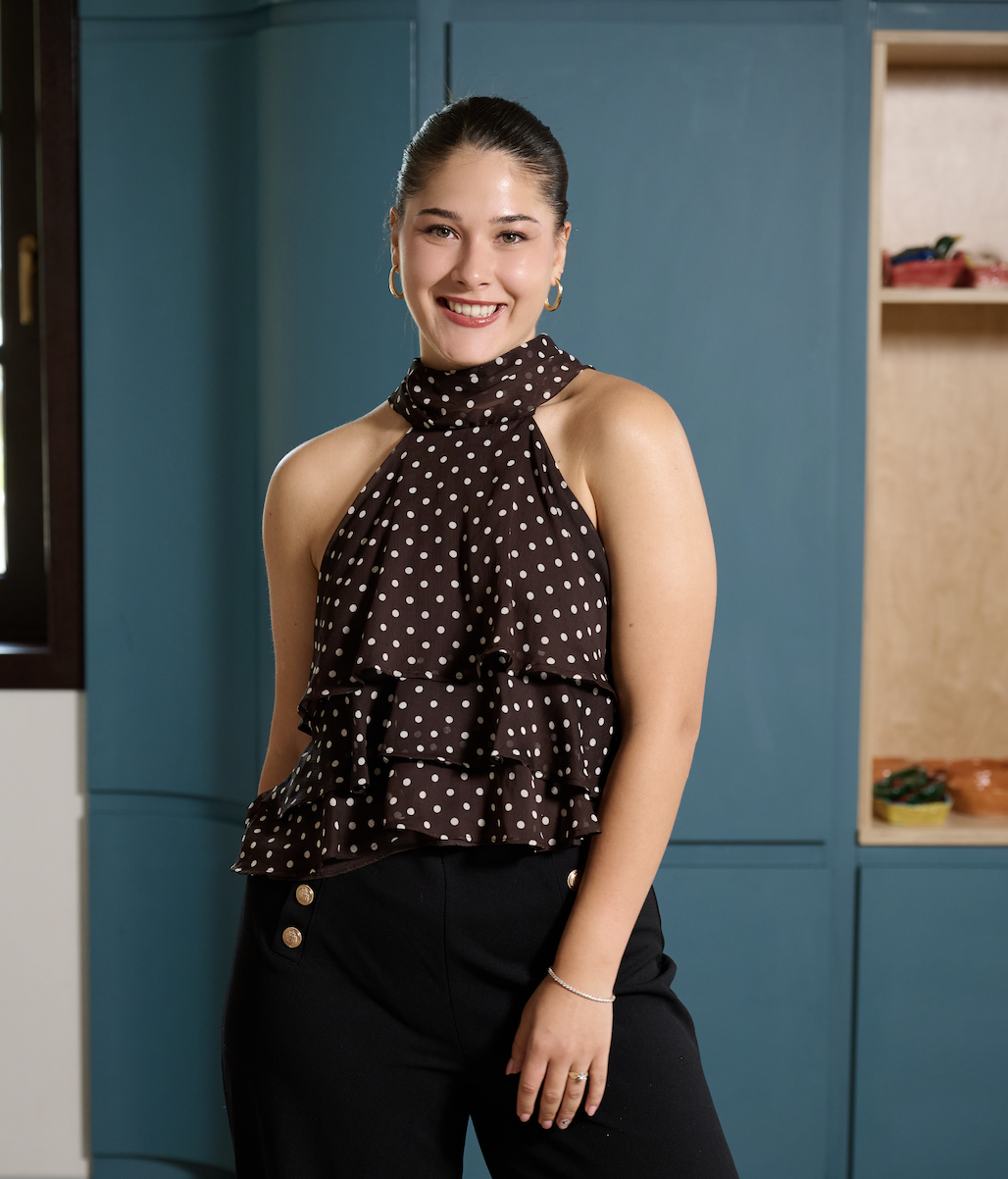
Meet Monica Durakovich
"If children are more connected to themselves, what could possibly go wrong? The world can only change for the better."
Monika is 23. She was born in Canada, grew up in Arbanasi, has danced hip-hop since seventh grade, and is one of the newest members of the teaching team at Arcus Junior.
I: Let's start with Monika who isn't a teacher. What kind of person are you outside school?
M: I'm a really positive person. I stay away from negative conversations. Sometimes I'm full of energy, sometimes I'm completely calm, and there's a balance between the two. I adore dancing. I danced hip-hop for eight years at a well-known dance school – I started in seventh grade and kept going until the end of twelfth. Before that I was a very shy, withdrawn child and found it hard to connect with people. Dancing opened me up as a person. The camps, the people from all over the country, all those different personalities – something just clicked in me. Through dance you express yourself and you feel at peace. It's my favourite period of my life, and to this day, whenever dancing comes up, I'm in.
The other thing is that I love adrenaline and challenges. I think they change you and make you grow. I'd rather things be hard – even though I don't like feeling nervous, and right now, with this interview and the new school, I'm a little nervous.
I: Where are you from?
M: I was born in Canada, in the French-speaking part. That's where my mother met my father, who is Macedonian – which explains my surname, which everyone asks me about. In Canada I went to a Montessori kindergarten. When I was six, my mother and I moved back to Arbanasi, where my whole family lives. I repeated the preparatory year so I could learn Bulgarian, then went to Patriarch Evtimiy School and a language high school with English and French. I still live in Arbanasi – and now I work in my own village too, which gives me a really good feeling.
I: How did you find your calling as a teacher?
M: It wasn't easy. In eleventh and twelfth grade I was preparing for medical school – private lessons in biology and chemistry – and it was torture. Something held me back, and in the end I didn't even sit the exams. I was lost about what to study. My family suggested I try education, because ever since I was little I've been like a radar for small children – wherever we go, they stick to me. I enrolled in Primary Education with a Foreign Language at the University of Veliko Tarnovo, but with a lot of doubt.
I: That "study medicine" sounds like pressure to choose a "successful" profession. I see a parallel with what we do here – the exact opposite of over-intellectualising childhood, of five clubs and four languages. Coming back to the present moment and listening to yourself.
M: Exactly. Sports and activities are good, but when there are too many, the child loses themselves. They don't know what they really enjoy, so they drop out of one thing after another. For my first two years at university I wondered why I was there. In my third year I decided I had to find out how I'd feel in a classroom, because theory is one thing and practice is another. I volunteered at a school in Belyakovets. Once again the children stuck to me, and I rediscovered teaching. For me it's a creative thing. I can't learn by rote and I don't like teaching straight from the book – I want children to develop their imagination and themselves. At the same time I'm a very organised person and a bit of a perfectionist – if I do something, it has to be polished from A to Z.
I: What did it feel like the first time you walked into a classroom full of children?
M: Scary. I was panicking. But children support you. They don't judge you – they're pure, and they're positive towards you because they sense that you're positive too. I even became friends with them – a bit more than I should have, and I'm still learning where the line is as a teacher. I liked that in front of them you can be yourself. There's no way to hide – they see you straight away.
I: How did you end up at Arcus Junior?
M: It was recommended to me, and I also knew a school was opening in Arbanasi. I'd heard about the interesting projects Arcus does from fifth to twelfth grade, and the education here is different too. I first heard about Waldorf education in my third year, and it sounded very calm and sensible to me – learning through play and experience. At university that approach is only touched on; the focus is on traditional teaching and multimedia. That's why I wrote my thesis on Waldorf education, and now I feel better prepared and more confident.
I: As someone who works with children – how would you describe a good childhood?
M: The kind I had. I'm grateful we moved to Bulgaria, because it wouldn't have been the same in Canada. A big group of kids on bikes – going from house to house and gathering everyone up. Playing until late, until your mum calls you to come home. Being free and having fun – that's how I picture it.
I: And how does our school create the conditions for that kind of childhood?
M: Here children are free to express their thoughts. There's teamwork, learning through play and hands-on work. There's a garden – being in nature, working with your hands, touching the soil. And there's a lot of free play. I remember the summer activities – Svetla sent me photos, and you could see how inventive the children are when they come up with what to do on their own. Their imagination is alive and awake.
When you give a child a phone or a tablet, you don't activate their imagination. You make them take in a huge amount of colourful, fast-moving information. But when they have to figure out what to do on their own, led by curiosity, their brain is working. A screen isn't real – you can't touch it. That's why I like that there's no multimedia here and learning is more like a fairy tale. The child has to picture things in their own head.
I: If you look deep inside yourself – what do you want to give the children by being here?
M: I want to give them calm and an environment where they can discover themselves. For them to be creators and to be curious. For them to leave my lesson with even more ideas in their heads, not thinking "that lesson was boring".
I: If we did this interview again in ten years – who is Monika the teacher at 33? Dream as big as you like.
M: More confident, I hope. By nature I'm a more reserved and anxious person, and confidence comes with experience. Clearer and more creative. Theatre really interests me – I want to dig into it, because it's so creative and it feels like my thing. I imagine something like a school that combines theatre and dance. When I do that, I'm overflowing with energy.And I can bring that here, to the students – give them something of myself. The truth is I can't picture it completely clearly yet. It's more of a dream.
I: And one last question. What would education in Bulgaria look like if every school worked in a holistic way?
M: I think students would come out more organised, more mature, more creative in their thinking and more proactive. I've noticed this with the older children at Arcus. They have the freedom to share their opinions and to speak in front of others – something we were never given. They express themselves better than some people my age. That's why I'm all for these elements in education. If children are more connected to themselves, what could possibly go wrong? The world can only change for the better.