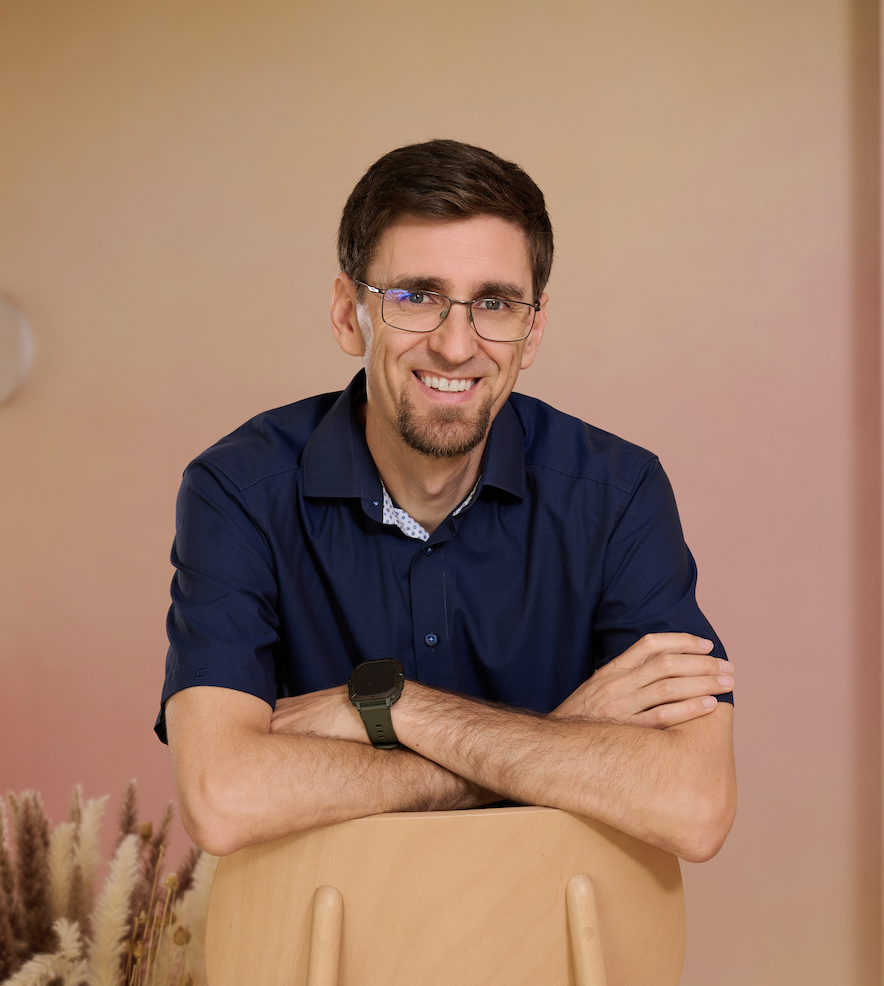
Meet Svetoslav Georgiev
“We can’t fit all children into the same mould and expect the same results.”
Interviewer: We can start with an introduction, if you’d like.
Svetoslav: My name is Svetoslav Georgiev, although most people know me simply as Svet. I’ve been teaching for about 10 years. I trained as an animation director and have worked in animation and game design. That’s what I was drawn to even in high school. I knew I wanted to work in animation. It turned out there was a degree program for it in Bulgaria.
I: Where exactly?
S: In Sofia, through Varna Free University. They had a Faculty of Film and Theatre Arts in Sofia. This was in the early 2000s, when the internet was still quite limited. YouTube was just getting started, and there was almost no information about animation. I knew a few basic things, but I didn’t really know the techniques and principles. When I started studying, I realized as early as my first year that I could have learned all of this 10 years earlier if the information had been more accessible.
I: Was that the only program of its kind in Bulgaria at the time?
S: There was one at the National Academy of Art as well, but there were very few places and it was difficult to get in. I don’t want to call it a matter of connections, but it wasn’t easy. That’s actually why this faculty at Varna Free University was created: the same professors from the Academy also taught us — Donyo Donev, Konstantin Djidrov, Dimitar Tomov… The program was very good, but I realized how much time I had lost. And I promised myself that one day, if I could, I would pass this knowledge on to children so they could learn it earlier and move forward with it. I didn’t do it right away because life took me in different directions and I traveled a lot. But I returned to Bulgaria around 2014, and my family, my sister and my wife, supported me and brought me back to what I love.
I: Which is?
S: Teaching. That’s how I started my own animation school in Veliko Tarnovo. At the time, there wasn’t another one like it in Bulgaria. We simply called it the Children’s Animation School. Over time, we expanded and added game design, while animation remained at the core. Now, I think, there is another school like it in Sofia, but when we started, what we were doing was genuinely innovative. Eventually, I also started teaching online. At the moment, I teach at five international online schools. I have students from all over the world, on every continent. I work early in the morning with Asia and Oceania, during the day with Europe and Africa, and in the evening with America.
I: That sounds like quite a demanding schedule.
S: It is, but now I’ll have to reorganize it because of my work here at the school. And exactly what we’ll be doing here gives me additional energy and satisfaction.
I: What made you decide to join the team?
S: Mostly because I’m a father. I have a daughter who is starting preschool now, and I want the best for her. I was invited to meet the team. I wasn’t planning to teach here, but my conversations with Yulia and Bilyana, and the energy and mission of the place, won me over. I can see that I can contribute not only with my experience in animation, but also with my whole philosophy of education. And what could be better than helping shape your own child’s education?
I: How do you understand the school’s mission?
S: For me, the mission is to prepare children for real life not only through academic knowledge, but also through the arts, practice and experience. To learn not only with their minds, but with their hands, their bodies and their emotions. Our education system neglects this. Every year, the arts give way to other subjects. There is something deeply wrong if a child is good at mathematics but not very good at visual arts and is still considered a good student. But if it’s the other way around — they’re great at drawing but struggle with mathematics — suddenly they’re no longer a “good” student. The system doesn’t look at where a child’s strengths lie and develop them. And that, in my opinion, is exactly what education should do.
I: And what exactly will you be teaching here? What does a typical working day look like for you?
S: The great thing about Arcus is that, unlike other schools, you don’t come in with a specific list of subjects you’re required to teach, regardless of whether they are your strengths. In most primary schools, teachers teach absolutely everything, from mathematics and language to visual arts, music, “Man and Society”… And often they don’t have enough training or confidence in those areas.
I: That sounds pretty overwhelming.
S: It is, and it isn’t effective. Someone who has studied pedagogy, in most cases, has only basic knowledge of art or music, enough to simply “cover the material.” But if you don’t feel it yourself, if you don’t teach it with emotion, children understand that immediately. They are incredibly sensitive beings. If you’re not passionate about what you teach, there’s no way you can truly pass that passion on to them.
I: So you chose the subjects yourself?
S: Yes. Right from the beginning, I told them that I didn’t feel comfortable teaching academic subjects. It’s not that I can’t, but to be fully effective, I would first need to go deeply into the material, and it isn’t something that comes naturally to me. And when you struggle with something, people can feel it. They were completely open to that. They asked me, “Okay, where do you feel strongest?” And I said: arts, music, sports, crafts. I’ve been doing these things for years. Music is my passion, I played basketball for a long time, and I love making things with my hands. When I teach these things, I genuinely have fun, and when I’m having fun, I can pass that emotion on to the children.
I: If we were to imagine the best possible scenario for you this school year, what would it look like? What would you want to experience, learn and give?
S: Honestly, I can’t wait to get started. We’ve been preparing, thinking and discussing things for so long, and now I want to see it happen in practice. I know it will be difficult because there are many new things for me as well, but that’s the good part: I’ll be learning. And what’s even better is that I’ll be able to give something and then see what happens on the other side, when what I give is received, understood and resonates. That is priceless.
The best thing would be to reach the end of the year and see that children who learn in this different, more holistic way are doing at least as well as their peers in traditional schools. That we’re not falling behind even though we’re not following the standard curriculum. Because many people worry about this. They think that if we learn outdoors, draw more, and learn to play the flute from first grade, then we’re sacrificing the academic side. But that isn’t true.
I: So alternative education isn’t “less”?
S: Exactly. Quite the opposite. It simply approaches things differently. I believe that if we can demonstrate this in practice, through results and happy children, we can change a lot. At least locally. And why not beyond that? I imagine people from other schools coming to see what we’re doing and exchange experience. If something works, it’s natural to want to apply it yourself. That’s exactly what gives me hope that we can be a driving force for change. That we can show another path.
I: It’s clear that this isn’t simply a job for you, but a personal mission.
S: Absolutely. I’m a parent myself. And I know how difficult it is to choose a school for your child. Especially if you’re not simply looking for somewhere to tick a box, but for a place that will accept your child as they are, support them and inspire them.
I: What advice would you give parents who are still unsure whether this school, this philosophy, is right for them?
S: I would tell them: look for your children’s strengths. Not the things they “should” be good at, but the things they are genuinely good at. Society puts pressure on us to be good at mathematics, languages… But the truth is that no two people are the same. Everyone has different talents and a different pace of learning. If your child is good at art, support them in that. If they’re good at sports, support that too. That’s how they will grow up confident and happy. Grades, diplomas… these are not measures of a person’s worth. They only have meaning if they are the result of something a child loves and does willingly. We can’t put every child into the same mold and expect identical results. That’s simply not how it works.
I: It seems to me that you’re saying things many parents feel, but don’t always allow themselves to follow through on.
S: Yes, and that’s why I would like this school to be not only a space for children, but also a community for parents, where we can talk about these things, learn together and help each other. Because ultimately, we adults are also in the process of learning. If we do what we love, we become better and happier parents. And as a result, our children grow up with more confidence and love.
Many of the children I work with are gamers. I’m a gamer too, I’m interested in esports, and that creates a bridge between us. I’ve heard so many times, “But you’re our parents’ age, how do you understand us?” And the answer is simple: because I’m interested in the things that matter to them.
I: And that’s something parents can do too, right?
S: Absolutely. You simply have to try to enter your child’s world, even just a little. If your child likes playing Brawl Stars, install it and play with them for a while. You’ll see how the dynamic between you changes. You’ll have something to talk about, a shared experience. And from there, they’ll start sharing other things with you. They’ll feel understood. That’s priceless.
Unfortunately, everything new and unfamiliar tends to cause rejection. “What is this Minecraft with the square heads?” “What is this TikTok?”… Instead of becoming curious, parents often reject these things because they’re not “theirs.” But a child isn’t a project you’re supposed to shape according to your own taste. They are a separate person. And if you want to be close to them, you need to understand them, not change them.
I: This brings us to a very important topic: the digital world children are growing up in today. It often frightens parents. How do you see it?
S: I see it as inevitable. And the sooner we accept that, the better. The world children live in today is digital. We can’t change that. But we can help them navigate it consciously. We can teach them to be critical, to use technology intentionally rather than simply consume it. And again, it’s not just about telling them, “Get off your phone!” You need to show them why. Or better yet, be there with them while they’re using it. Ask them questions. Have a shared interest.
I: So rather than fighting their world, we should enter it together with them?
S: Exactly. When a parent understands their child’s interests, they create a bridge between them that nothing else can replace. It’s not about being their friend at all costs, but about being there with them in the reality they live in. And it’s different from ours. A lot of people from our generation still can’t accept that. They think children “don’t know what they’re doing.” But actually, children often know very well what they’re doing; we just don’t know how to see it.
I: And if you could give the parents who will read this interview one piece of advice, what would it be?
S: Look closely at your children. Don’t push them in directions where they themselves don’t feel strong. Let them shine where they naturally have an ability. Because every person has their own place and their own strength. Real, living education isn’t about everyone being equally good at mathematics or literature. It’s about each person discovering what they are good at and being supported in developing it.
I: They feel the same way in real life and in this online world. They communicate with their peers in much the same way, and little by little, the boundary between what happens in reality and what happens online starts to blur. If a parent doesn’t simply stand on the outside, but decides to cross that wall and enter this other world, not in order to control or reject it, but simply to see what is happening with their child there, then an opportunity for a genuine connection opens up. Not to hide, not to pretend that this doesn’t exist, but to be there with them.
S: Yes. And I imagine that in this online world, children often feel lonely. They are on their own there. They discover things on their own, make their own choices, get lost and find their way again on their own. Recently, I came across a series called Adolescence. I haven’t gotten around to watching it yet, but I know what it’s about. If anyone decides to watch it, they should be prepared because it’s emotionally heavy. But there’s one very simple idea in it: take your child by the hand and enter this world together. See what’s inside and how you can deal with it. Without accusations, without fear.
I: Yes, it sounds simple, but it seems to still be difficult for many people.
S: Maybe that’s changing. The generation of people who are having children now has already grown up with technology. They will have played games, been on the internet, and they’ll know what it’s like. They’ll know what their children are going through. Whereas parents from previous generations often simply don’t understand. And when you don’t understand something, you don’t know how to respond. And when you don’t know how to respond, you start rejecting it or suppressing it. This is something we can’t avoid. Technology isn’t going to disappear. We simply have to adapt to it, both us and our children. But that doesn’t mean a child should spend 10 hours in front of a screen. Yes, it’s good to give them the freedom to play, but within reasonable limits. Games teach you many things. But if you go too far, you reach a point where you either need to do it professionally or you’re simply wasting your time.
I: How do you identify a child’s interest and channel it?
S: First, of course, the child needs to have the opportunity to try many different things. That’s why we combine subjects, methodologies and experiences. But when a clear interest emerges, that’s when the teacher’s important role comes in. To see it, recognize it, name it and tell the parents: “Your child has a talent here.”
I: But then we come to another question: will the parent accept that assessment?
S: Yes. Will they trust the teacher? Because that person spends the whole day with their child. Maybe they see things the parent doesn’t notice. If the family gives it a chance, whether through lessons, additional activities or something else, it can unlock potential. But that requires trust in the teacher.
And it isn’t easy if your child is good at something you don’t like. If you want them to become a chemist, but they’re drawn to drawing, woodcarving or esports. Then we once again come up against the tension between the idea you have of your child and who they really are.
I: So perhaps it’s valuable to clarify the school’s approach right from the beginning.
S: Exactly. In our meetings with parents, we explain that we are not entirely Waldorf, but we have Waldorf elements and an alternative approach. And the children will not be doing the same things they would in a state school. Yes, boys will knit. Yes, girls will do woodcarving. And that’s great. Everyone should try everything in order to discover what they’re good at. And you can never know what you’re good at if you haven’t tried it.